
We honestly thought buying new anchor chain was going to be one of the easier jobs on Tangaroa. We would look at what we already had, figure out the size, order 600 feet of the same thing, install it and move on to the next project.
That was the plan anyway.
The problem was that the chain that came with Tangaroa had never really fit our old Ideal windlass properly. It worked, but it was never smooth, and whenever we backed down hard to set the anchor, the chain could jump in the gypsy instead of seating properly. Over the years it had also become increasingly rusty, especially at the anchor end where it saw the most salt water, so by the time we started preparing Tangaroa for longer-range cruising, we knew replacing it was no longer optional.
Alaska changed how we looked at our ground tackle
Our time in Alaska made the decision even easier.
A lot of the anchorages we used were deep, and on quite a few nights we had 300 to 350 feet of chain out. When you only carry about 400 feet aboard, that does not leave much in reserve. Add steep-sided fjords, rapidly changing depths and wind funneling down the mountains, and suddenly the amount of chain sitting in your locker becomes something you think about a lot more seriously.
Before heading farther north and eventually across the Pacific, we decided we wanted at least 600 feet of new chain aboard.
At that point, the job still seemed straightforward. We just had to work out what size to buy.
That turned out to be much harder than expected.
What chain was this windlass actually designed for?
Normally, replacing anchor chain is fairly simple. You either replace the existing chain with the same size, or you identify the windlass and gypsy and look up the specifications.
Neither option worked for us.
We already suspected the chain on Tangaroa was wrong because of how loosely it sat in the gypsy and how easily it could slip. Blaine started looking more closely at the windlass and found a number stamped into the gypsy: 25.
We thought we had solved it.
Since our windlass is an old Ideal unit and Schaefer Marine later acquired Ideal, we contacted them expecting they would be able to tell us exactly what chain that gypsy had been designed for.
They could not.
They had no record of that particular number, which meant we were back to square one with a very old windlass and no reliable way to identify the chain it originally used.
We tried the obvious next step
Blaine removed the gypsy and started taking it around to marine suppliers and chandleries in Victoria and Vancouver, hoping somebody would recognize it and tell us immediately what size we needed.
That did not happen either.
Most places were not sure what chain it required, and several did not even stock chain in the larger sizes we were considering. What surprised us most was that the general suggestion seemed to be to order the chain and see whether it fit afterward.
That might be fine if you are buying a short length.
We were planning to order 600 feet.
We were not interested in spending that kind of money, dealing with that much weight, and then discovering we had bought the wrong thing.
Then we learned that chain sizing is not nearly as simple as it sounds
Up until this point, we had been thinking of anchor chain in fairly simple terms. If it was 3/8-inch chain, then surely 3/8-inch chain was 3/8-inch chain.
It turns out that is not enough information.
There are imperial and metric chains, different standards, different link dimensions and different pitches. Two chains can look almost identical sitting next to each other and still behave completely differently once they start running through a windlass.
That was when our old chain started making a lot more sense.
Maybe it was not simply worn out. Maybe it had never been the correct chain for the windlass in the first place.
That is where Shakesure came in
Around this time, we connected with Owen from Shakesure Chains. It was one of those funny internet coincidences where we were online trying to find somebody who really understood anchor-chain sizing, while the Shakesure team had been watching our videos and had already seen us struggling with the problem.
Owen started asking us for measurements, photos, videos and dimensions from the windlass. He also explained something we had not really understood before: chain pitch.
The spacing between the links matters a lot more than we realized. A difference of only a millimetre or two can completely change the way a chain sits in a gypsy. If the pitch is wrong, the chain can climb, jump, bind, fail to release properly or simply run roughly through the windlass.
That description sounded very familiar because it was exactly what our old chain had been doing.
What impressed us most was that Owen did not tell us to order a bunch of chain and hope for the best. Instead, he suggested sending us multiple samples so we could physically test them in the gypsy before making any decision.
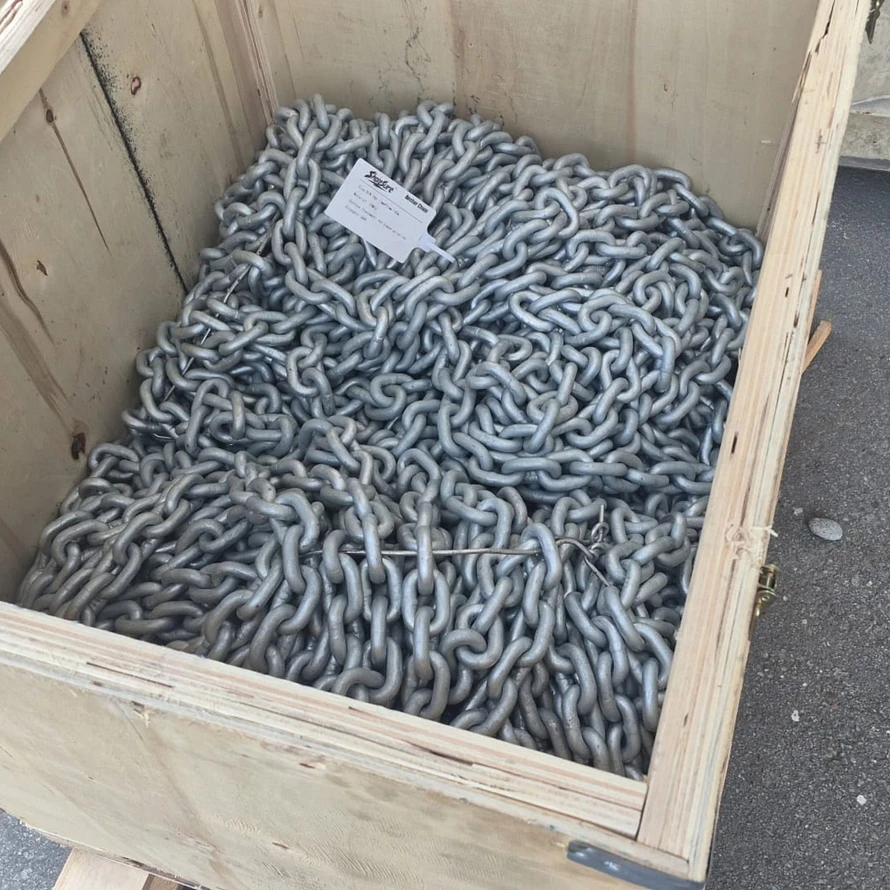
A very heavy box of chain samples
A little while later, a package arrived with several short lengths of different chain.
Some of them were rusty, some had different finishes and none of that mattered because these were not samples for choosing the final finish. We were simply trying to determine the correct dimensions.
There were different versions of 3/8-inch chain, 7/16-inch chain, 10 mm chain and 11 mm chain, so we took them over to the windlass and started testing them one by one.
We laid each sample into the gypsy, rotated it around, checked how deeply the links sat in the pockets, looked at how much movement there was and then watched whether the following links continued to line up correctly as the chain wrapped around.
Some samples looked decent at first but were still too loose. Others fit the first pocket reasonably well, but farther around the gypsy the pitch was wrong and the next links stopped lining up properly.
Then we tried the 11 mm chain.
That was the one.
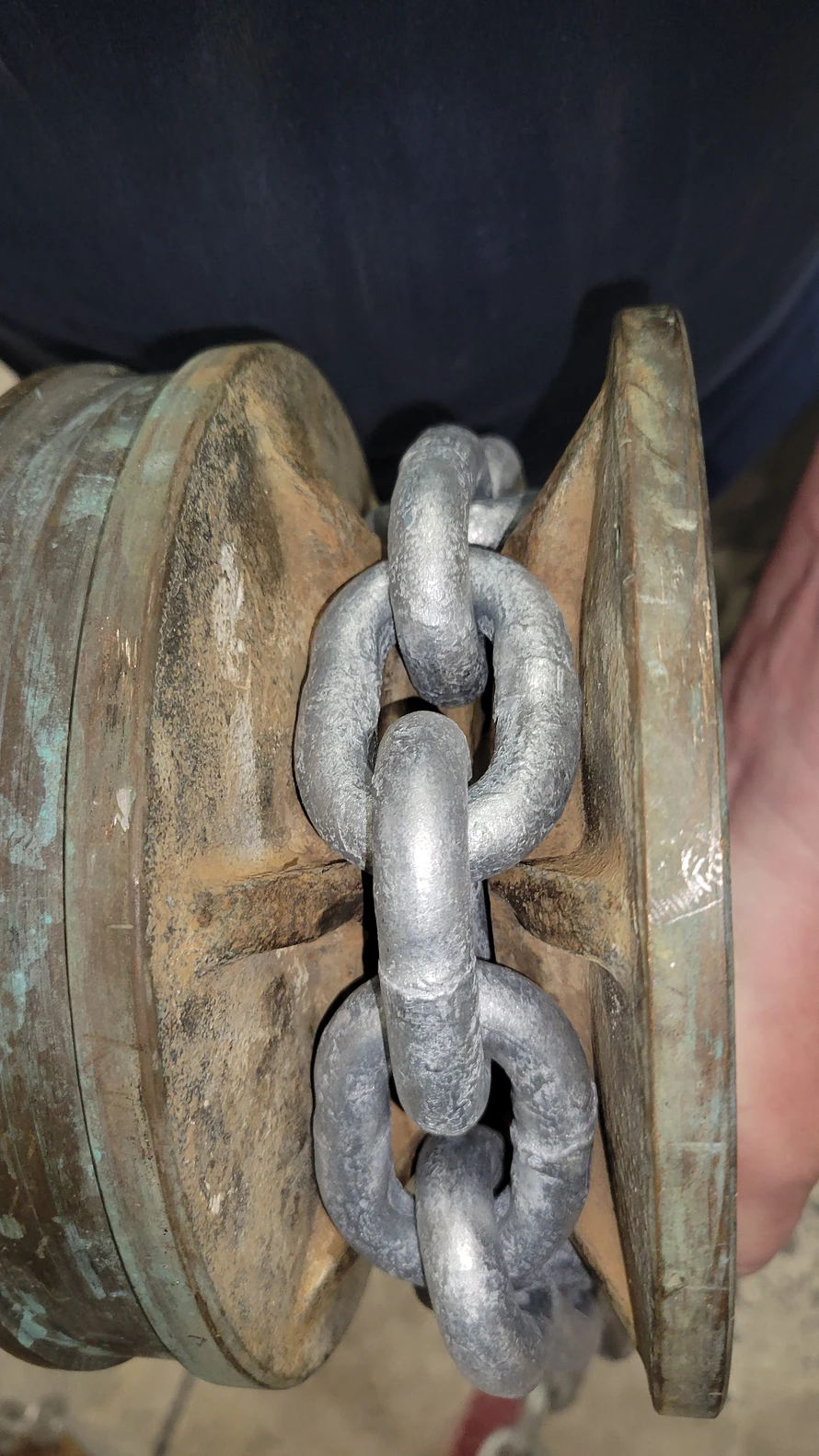
The links sat more securely in the pockets, there was noticeably less movement, and as the chain moved farther around the gypsy, the links continued to line up correctly.
After all that, we finally had our answer.
Tangaroa's windlass appears to have been designed for 11 mm DIN766 chain.
Suddenly, the whole problem made sense
11 mm DIN766 was not a size we had even been considering when we started this process, which also explained why we had such a hard time finding the right answer locally.
When we compared the 11 mm chain with what had been on Tangaroa, the difference was much easier to see. The new chain had a larger link diameter and slightly different link dimensions, which matched the spacing of the pockets in the gypsy much better.
It also gives us more strength, which is something we are very happy about considering where we intend to take the boat.
Finding the right chain also exposed another problem
Of course, once Blaine had the windlass apart and could properly inspect the gypsy, he could see that years of use had worn parts of the bronze pockets away.
That wear would also contribute to chain slippage, so before the new chain goes into service, he plans to repair the worn areas with silicon bronze and rebuild the sections that have been eaten away.
The encouraging part is that when the 11 mm chain is positioned where it should sit, the links line up properly with the remaining structure of the gypsy. Once those worn areas are repaired, the whole setup should work much better than it ever has during the years we have owned Tangaroa.
Shakesure is now sponsoring Tangaroa's new chain
After going through this whole process with us, Shakesure Chains is now sponsoring Tangaroa's replacement anchor chain, and we will be installing 600 feet of 11 mm galvanized chain.
We want to be completely transparent about that.
We are not paying for the chain.
But the sponsorship came after the problem-solving process had already begun, and that matters to us. Owen spent months helping us work through measurements, photos, videos and chain samples before we ever got to the point of ordering the final chain.
That is a big reason we felt comfortable working with Shakesure.
It never felt like, “Here is our product, now say something nice about it.”
It felt like, “Let’s figure out what your boat actually needs.”
Now we just have to install 600 feet of it
Finding the correct chain does not mean the anchor project is finished.
We still have work to do in the anchor locker, the gypsy needs repairing, the chain roller arrangement needs some redesign, and we are also changing the anchor itself. Like most projects on Tangaroa, solving one problem has exposed several more.
But after spending roughly a year trying to answer what sounded like a very simple question, we finally know what belongs on this boat.
11 mm DIN766 galvanized chain.
For us, the interesting part of this whole process was not really the chain itself. It was realizing how much goes into getting something this basic right on an older boat, especially when the original records are gone and the equipment has been altered over the decades.
Sometimes refitting a 57-year-old yacht is less about replacing parts and more about doing detective work.
In this case, the answer happened to arrive in a very heavy box full of chain samples.
FOR 15% OFF ANCHOR CHAIN USE THE CODE "TANGAROA"