
Real World Hybrid-Electric Conversion
Quiet Power for a Boat We Love
We’re officially doing it.
Tangaroa is going hybrid-electric, and we’re sharing the entire build in real time on our Never-Ending Sea Trial YouTube channel.
Before Tangaroa, we were sailors — over 100,000 nautical miles under sail and a full circumnavigation. Even though this is our first powerboat, Janis has always missed that moment sailors know well, when the engine shuts down and everything goes quiet. That calm matters to us.
We’re partnering with OSEA Boats, the new company founded by Brent Perry, because their approach aligns with how we cruise: practical, honest, and built for real boats in real conditions.
This hybrid-electric build isn’t free. We’re putting our own money into a system we believe in because we want to prove — openly and honestly — that hybrid-electric propulsion can work on a full-size, long-range motor yacht.
Same boat.
Less fuel.
No noise.
If you’d like to support this crowd-funded project and follow along as it happens, you can join us on Patreon or through our website:
OSEA:
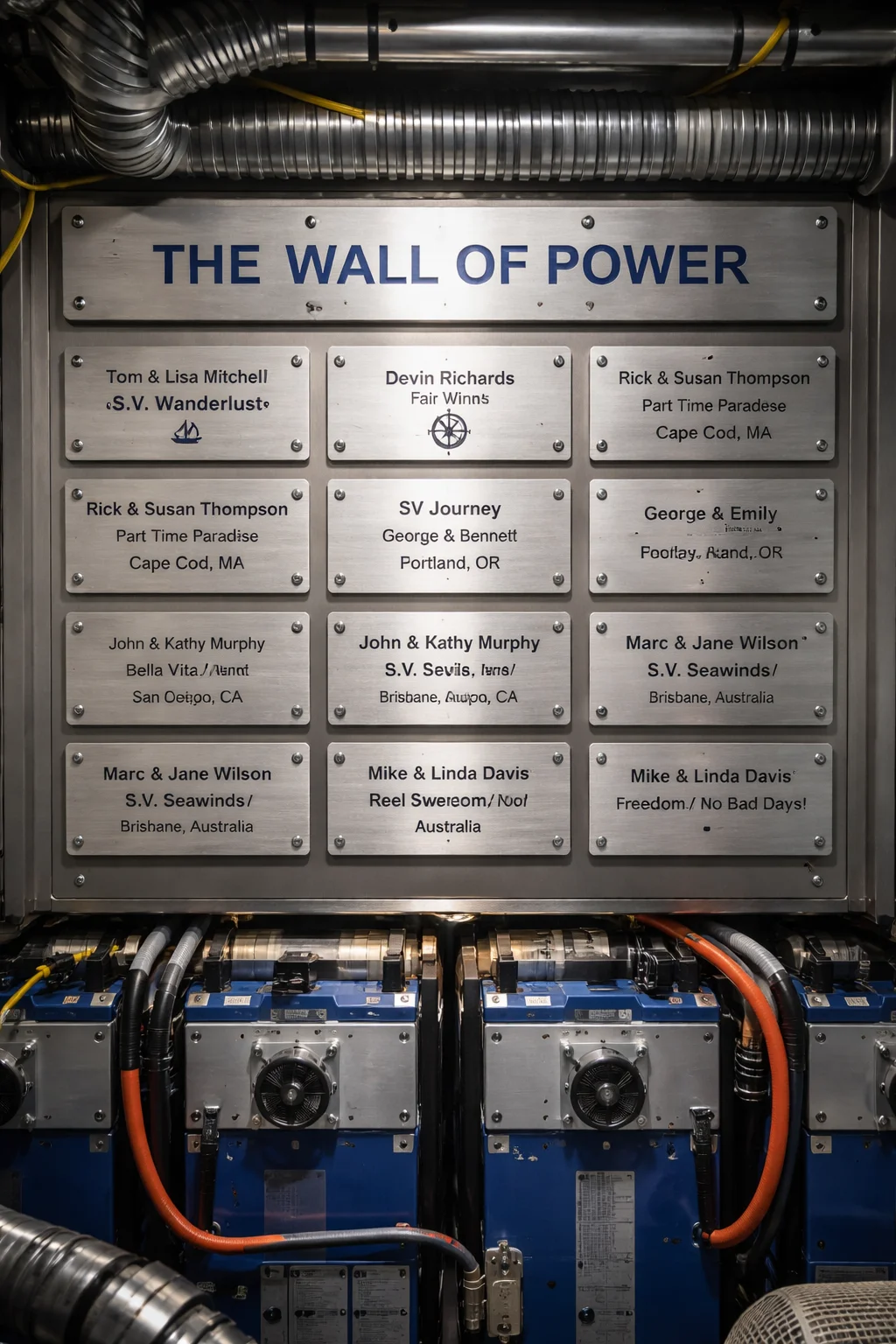
Wall of Power
This hybrid-electric build is a crowd-funded project, and the Wall of Power is our way of saying a very real thank-you to the people who make it possible. Our top-tier First Mate members will have their name engraved on a 3" × 5" aluminum plaque, along with a boat name, hometown, or short quote—whatever they’d like to be remembered by. These plaques will be mounted permanently inside Tangaroa’s engine room as part of the hybrid-electric conversion (we’re leaning toward the lithium battery bank doors, but the final location is still being worked out).
Supporters aren’t just helping fund the build—they’re helping us show, openly and in real time, what hybrid-electric propulsion is capable of on a full-size cruising boat. We share the entire process through three detailed videos every week, plus a weekly live Q&A where we answer questions, explain decisions, and talk honestly about what’s working and what isn’t.
As an ongoing thank-you, Wall of Power members and our Online Crew will also be listed at the end of every video throughout this project—your name on YouTube, seen by thousands, as part of Tangaroa’s story and this hybrid-electric conversion.
For those who prefer a one-time option, plaques are also available for a $500 USD contribution.
Be Part of the Wall of Power—Forever
Make a permanent mark on this hybrid-electric build. A $500 USD contribution secures your 3" × 5" engraved aluminum plaque on Tangaroa’s Wall of Power, mounted in the engine room as part of the conversion itself. Your name—plus a boat name, hometown, or short quote—will live onboard forever, and you’ll be recognized at the end of every video as we share this project in real time.
Hybrid-Electric Q&A — Your Questions Answered
These questions came straight from our very first YouTube live about turning Tangaroa into a hybrid-electric boat. Some were technical, some were practical, and a few made us stop and think — which is usually a good sign. This Q&A pulls them all together in one place, with honest answers based on what we know right now. The build is happening in real time, so a few answers may change as we learn more, but the goal stays the same: explain why we’re doing this, how it works, and what it’s really like to rethink propulsion on a 78-foot boat.
Why Hybrid at All?
We get asked this one a lot: why hybrid-electric? For us, it came down to how we actually use the boat. Most of the time we’re cruising at hull speed or sitting at anchor, not running flat out. Hybrid lets us use only the power we need, when we need it — without listening to engines and generators all day. The quiet part mattered more to us than we expected.
Why Not Just Solar?
Solar is great… when the sun shows up. We spend a lot of time in places where it doesn’t. Winter in the PNW, cloudy stretches, monsoon weather — solar alone just isn’t reliable enough. Hybrid lets us use solar when it’s available, but we’re not stuck waiting for sunshine to live normally onboard.
Quiet Was the Game Changer
One thing we didn’t fully appreciate until we started planning this was how much noise affects everyday life onboard. Being able to cruise quietly and sit at anchor without a generator running changes the whole feel of the boat. It’s hard to explain until you experience it — but once you do, it’s tough to go back.
Weight Isn’t a Bad Thing
People worry about battery weight, but in our case it’s actually a benefit. We removed thousands of pounds when the old engines came out. Batteries put that weight back low in the hull, right where you want it, improving stability and ride comfort.
Will the Boat Be Slower?
Short answer: no. Electric motors are incredibly efficient, and the boat will perform just as well as it does now. We’ll still have plenty of power when we need it — we just won’t be wasting it.
Why We’re Keeping the Props (For Now)
We’re not changing the propellers right away. We already have great baseline data with the current setup, and we want real-world numbers before making changes. Once we’ve run the hybrid system for a while, we can fine-tune things if it makes sense.
Solar’s Real Job
Solar isn’t there to push the boat. Its job is to stretch time. It offsets daily power use, extends time between generator runs, and quietly does its thing in the background. Over a few days, it really adds up.
Battery Safety
Battery safety is something we take very seriously. This system uses lithium iron phosphate batteries, liquid cooling, certified modules, and dedicated fire suppression. It’s not experimental — it’s proven technology being used in commercial applications all over the world.
Cold Weather Reality
Lithium batteries don’t love the cold, and we learned that the hard way with our existing system. That’s why this setup includes proper temperature control for the battery room. Keeping them warm isn’t just about performance — it’s about protecting their long-term health.
Serial vs Parallel Hybrid
We spent a lot of time choosing between a serial and parallel hybrid system. In the end, reliability won. A serial system is simpler, easier to troubleshoot, and better supported when you’re far from home. When you’re crossing oceans, boring and reliable beats clever and complicated every time.
But You’re Still Burning Diesel…”
Yep. And that’s a fair question. The difference is how the diesel is used. Small generators running steadily at their most efficient point burn far less fuel than big engines constantly speeding up and slowing down. Less fuel, less wear, and a lot less noise. It’s not about eliminating diesel overnight — it’s about using a lot less of it, smarter.
How Much Power Does a Big Boat Really Need?
This surprised us too. At cruising speed, Tangaroa only needs about 50 kW total. When you compare that to two large diesel engines, it really changes how you think about efficiency. Most of the power was never being used properly in the first place.
Multiple Generators, Not One Big One
Instead of one massive generator, we’re planning on several smaller ones. Most of the time, we’ll only run one — right in its sweet spot. That means better fuel efficiency, less maintenance, and built-in redundancy. If one goes down, the boat still runs.
Living at Anchor
One of our goals with this system is long, quiet stays at anchor. With the battery capacity we’re planning, we can live normally for four to five days without running a generator. That’s cooking, lights, computers, and all the usual stuff — without the constant background noise.
Charging Isn’t an All-Day Thing
A lot of people assume charging batteries takes forever. In reality, with the generators running, it takes about an hour and a half to two hours to recharge the bank. Short, efficient runs instead of long, noisy ones.
No Pods, On Purpose
Pod drives are impressive, but they’re not right for this boat or how we travel. They’re expensive, complicated, and vulnerable to damage. Traditional shafts are proven, tough, and easier to fix in remote places — which matters to us.
Recycling Isn’t What It Used to Be
Lithium recycling has come a long way. Cells can be replaced individually, materials are recovered, and packs don’t have to be scrapped as a whole. It’s not perfect, but it’s far better than most people think.
This Is a Long-Term Decision
Hybrid-electric isn’t a trend for us — it’s a long-term choice. It fits how we travel, where we travel, and how we want life onboard to feel. Quiet, efficient, and practical won out over tradition.